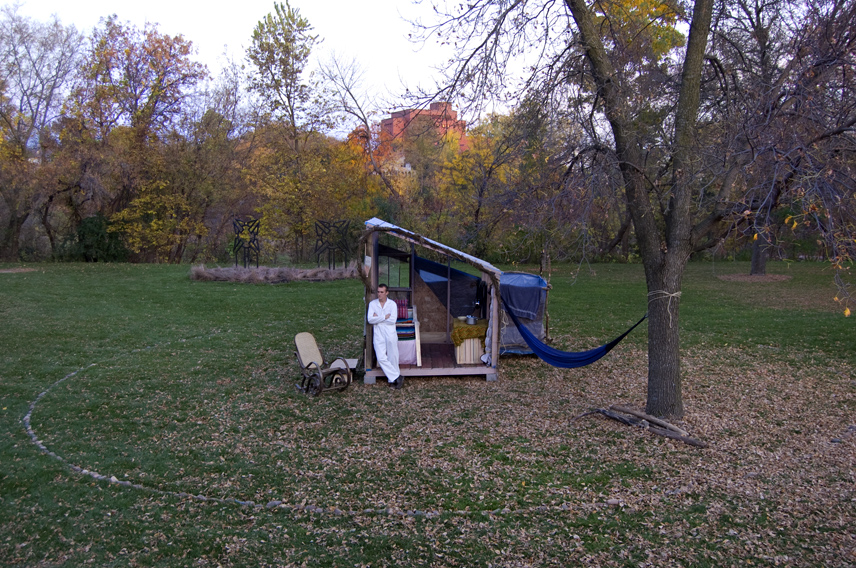
Thursday, October 14, 2010

13 October (Part 2)

Today just could not fit into one blog.  Around 6 p.m. Zac Barnes picked me up on his grand steed (a tandem bicycle that remains nameless as far as I know).  Zac has been wonderful.  He has brought me fresh produce from local community gardens for the past couple of days and told me so many wonderful things about Eau Claire that I would have never otherwise known.  With his, and other’s amazing contributions of non-purchased food items, I will be able to live on less than $1 a day for the duration of the week.

So off we galloped (kind of) on the twists and turns that are Eau Claire’s bike paths.  I felt like I was on a roller coaster and on more than one occasion I had to subtle remind Zac, “Buddy, you know my life is in your hands right?”  We finally arrived at the community gardens near Phoenix Park and it was beautiful.  Lines and lines of well cared for plants lay atop perfectly sculpted mounds.  The sun was setting on the day and the growing season but Zac showed me how they had recently planted barley so as to enrich the soil with more Nitrogen for the next growing season.  We talked about his own adventures in Latin America and how he would love to go back to start local food growing trends in developing cities and towns.  Most of the fertile growing areas in Latin America are used up by large corporations to produce cash crops, such as bananas and coffee.  This same land could be used to feed a hungry nation.  After all, $2 a day goes a whole lot further when you can pick your food daily from a community garden.  

I have been thinking lately that my project is only the first step in a long process.  Getting to know more about the human condition is one thing, but identifying a problem and finding a solution is something entirely different.  Through La Sed  (Latin American Sustainability and Development), an on campus organization my friends and I started I have had a taste of that sort of action in motion.  If you are interested in what we have done please visit http://www.uwec.edu/lased/about/mission.htm. 

When I got back to my shanty Maria was there waiting for me.  I almost jumped out of my (now a little dingy) jump suit.  It felt so good to have somebody to hold or cook with.  Something that I feel that bonds us as human beings more than anything is love.  The love that we share can transcend any boundaries.  With Maria and I there are times when we don’t even need words.  We just know.  I just know, when she’s here with me, the shanty feel more like home.


13 October (Part 1)


What a day. I guess the only place to begin is in the beginning. Having my only class canceled today I set out in the morning to get a whole lot done on my rock “walls.” I am really intrigued by the physicality of moving the stones. My joints and muscles ache from the abnormal stress, but each and every day gets a little bit easier, I get a little bit stronger. I finally have a visual when I talk about the “boundaries” that we construct between one another those that inhibit this idea of empathy or understanding I am trying to achieve. More and more people are crossing over these superficial boundaries, crossing over their own boundaries and fears and talking to me. Over the course of the morning I talked to two Gideons who, I would come to learn, are a group of men of many different denominations out to simply share the word of God. In my “real world” I often see men like these two holding bibles and I do my very best to not make eye contact, not give them a bit of myself so that they won’t try and push their beliefs on me. These two men were nothing like what I expected. They were very interested in my work and didn’t try and push anything on me. They just handed me the New Testament with a smile and said, enjoy!

I met a professor of Anthropology and Spanish. I met some tattoo clad cyclists who told me where to get lots of empty wine bottles for my work. And all the while, talking to these people I realized,
I would have never had the pleasure to meet them had it not been for this project. But my favorite of the day had to be Cliff. Cliff circled around my shanty at least a dozen times. He watched me work, he watched me engage with many different people, but all the while he kept a healthy distance. Finally Cliff staggered up to me, favoring what looked to be a hip that was 70 years old or more. We talked about my piece, and he told me about himself. He is from Illinois, in town with his wife to visit their daughter who went to school at Stout but now works in Eau Claire. It hurt him to tell me that his wife had gotten sick and she was at the hospital, but he had good faith that she would be just fine. She’s a tough old bird after all. Finally we got to talking about the rock walls which he was especially fond of. I told him they represent the things that hold us back from truly knowing other people. I told him that some people walk on by and never find out who I am or what this is all about. That’s when he looked up at me and with that grandfathery wink said, “Just like me! I circled around this thing for 15 minutes debating with myself whether or not I should come talk to you!” That’s when I asked him if he regretted his decision and he replied. “No way, this is great!”

Thanks Cliff.


Wednesday, October 13, 2010

12 October 2010


It's the little things I've noticed thus far.  My perception is changing little by little.  Before I go to bed, I have to think about what I will eat the next day.  Do I need to soak some beans overnight?  I have one tomato that is getting soft-- how can I work that into breakfast?  The little things.  Like putting aside 15 minutes every time I need to fill my canteen.  The little things like conserving my legs so I won't be too sore to carry stones the next day.

I've read about villages in Africa where the women spend on average 5 hours per day collecting heavy jerry cans of water for their families.  Time.  Time that could be spent starting a business, or getting an education.  Time spent away from children, often times leaving toddlers to watch over infants, because you'd better believe if you're old enough to carry a can, you're going with mom.  If you give people clean water, you give them their time.   You give them a chance.  

Today was tough, for all the reasons I didn't want it to be.  My "real world" would not leave me be today.  I had an exam on world architecture, seven hours of class, a brother wondering what the status with his bachelor's party was, and constant reminders in the form of flapping black and white fliers, and I still need to find a subleaser for my place next semester.  This is where my breed of empathy falls short.  I want to immerse myself completely in the lives of these people.  But my life keeps getting in the way.  These are the boundaries we construct.  

Thank you to all of you who have stepped over such boundaries and talked to me over the past two days.  You keep me going.  


Tuesday, October 12, 2010

11 October 2010

I got to thinking about gorillas today.  Recently, I was at the Bronx zoo, and I felt captivated by the gorillas there. But the curious thing about them was that they seemed to have no interest in we humans. The silverback led his family in an utter protest of our existence and presence.  I remember looking at their hands, so much like my own, and just starting at those dejected faces. 

I found myself turning my back to the viewer a couple of times today.  After I had set up my hammock, I laid in it away from the onlookers, and I ate carrots silently.  Just like people at the zoo, the curiosity of my own viewers led them to come into my space.  I had a conversation with two young men, one stood outside of the rock barrier, the other hopped right in. the one who stayed outside thought that perhaps it was a religious barrier and didn’t want to cross it.  The one who hopped right in said "I saw him eating carrots, so I thought it was an environmental piece".  The interesting thing was that I want the viewer to come into my life, but it will take some getting used to when your home is quite literally a stage. 

My diet this week with my $2 a day limit will consist primarily of rice and beans, and a few other fresh fruits and vegetables.  I will be wearing the same white suit for the duration of the piece, so as to disassociate myself with any particular group.  My shanty has reference to those I saw in El Fortín, and other Latin American communities.  However, the materials scavenged (and sometimes purchased) definitely have a north woods feel. 

I want my message to be one of hope and empowerment.  This evening, two young women visited the shanty in complete darkness.  After a short conversation, one of them said, "I wish there were more people like you."  In reality, there are millions of people doing better things than me.  Their shanties are just not so visible. 

A special thanks to Lee Wegener for documenting my performance, and to Maria Boland for everything that she is to me.


Monday, October 11, 2010

A Brief History


Juancito (far right) and some buds with their versions of life preservers at Lake Nicaragua, 2009 


Estefani and me fooling around on the greenhouse site, 2006


     Many people have already asked me, “Why are you doing this?”  Why would you put yourself through it?” In 2006 I studied abroad in Costa Rica and Nicaragua.  It was my first time out of the country and really my first taste of true poverty on a grand scale.  Our group had the pleasure of participating in a service project where we lived in a rural impoverished village called El Fortín (Nicaragua) and we worked with the people to build a greenhouse and plant over one hundred fruit trees so that they would have fresh fruit to eat and herbs to sell at local markets. 
     I kept a journal during my experience and I believe the following entry sums up most accurately the why behind this project:

            “Change the world.  It's easy if you try.

I was convinced it didn’t get any better than I had had it.  I was convinced we would meet and greet the same sort of faces we have grown accustomed to... meet and greet the same beauty we have almost grown numb to.  I was convinced I had been molded and remolded ten times over, nine times too many, the eleventh time was the charm.  I was convinced I couldn’t save the world, and then I met the children of El Fortín, Nicaragua. Our first day we rode up like rock stars, cramped people in cramped houses, rushed out in silence to the only cramped dirt road in the entire town.  We had only driven 5 miles from the city of Granada, but it seemed like we were a thousand miles away.  Pregnant moms in their early twenties shuffle their 2 and 3 year olds in tired rags, once again.  Kids old enough to walk the street do so on naked feet with eyes wide open.  I had no idea what I was driving into. 
            
     When I met yet another family, they sat me down in their one room house; in plastic chairs they surrounded me with curious eyes.  Nine of them sat, stared, said absolutely nothing... the only movement was that of my 20 year old sister breast feeding her 1 year old two feet in front of me.  My encounter.
          
     I would come to find out that true compassion isn’t money bought.  Love can be achieved in eight short days; tears fall harder on dirt roads, and no matter how beautiful a place can be there is always something to obscure pure sight.
         Every day we worked as a team, we used our hands; we created something beautiful, together.  A greenhouse with herbs to heal, plants to eat, bushes to sell is what resulted, but it could have been anything.  The magic was in the relationships built, without nails, without wood, but with something else I’m still trying to put my finger on.  The true beauty was in the eyes of Estefani, or the smile of little Juancito.  In school you work hard, and you learn.  Not every day reveals results.  In El Fortín, I came home every day with sore muscles from the day’s work, with sore muscles from my bed that was little more than a quilt draped over a steel frame.  With one particular sore muscle for the children who don’t have the means to buy a uniform to go to school or rice for dinner.  But every day I saw results.  I saw smiles.  I saw people, interacting with people, for the greater good of the whole rather than the individual.  for 8 days my sense of self fell away... for 8 days I lived and loved like it would all be gone in 8 days... for 8 days I was so incredibly me.  When our 8 days were over we left the town in the same converted school bus in which we had come, and once again we were stars, but this time we left a part of ourselves--and even as we drove further and further away and became just faces behind glass plate windows we were close enough to touch.
 
           
     So even if it is the life of one bright eyed child--change the world.”

            I am doing this project for my family in El Fortín and for the billions worldwide that must live in poverty each and every day.  I am doing this project for me, to better understand the human condition through its highest highs and it lowest lows.  I am doing this project because as a young artist I believe art still possesses the ability to promote change.  I’m not naïve enough to think that this piece will end world hunger, but if it changes just one mind and challenges that mind to act.  Well, I guess it’s a start. 

Thursday, September 23, 2010

Todos Somos (An Artist Statement)

Todos somos iguales.  Todos somos diferentes.  We are all the same.  We are all different.  It is easy to see that which separates us, for example: religion, cultural/national borders, life experience, and notions of personal identity.  However, the more and more I come to know the world and its people, the more and more I find common ground on which we can all stand.  Understanding and misunderstanding: these ideas are essential to the pursuit of empathy—and by extension, empathy is essential to my work.  When I travel to a new place I attempt to immerse myself completely in the culture and its people so as to understand.  When I create my work I try and access a similar mindset in regards to people, especially those who are poor and marginalized.
Through process, objects, and performance I try and understand the human condition as best as I can.  I create scenes and environments that are alien, almost shocking, to me and my Midwestern surroundings.  At the same time, these images are seen as commonplace elsewhere in the world.  Through this juxtaposition of the expected and the unexpected, ideas of poverty, struggle, and suffering invade a world consumed by Blackberry beeps and beckoning to-do lists.
Misunderstanding could be the most human notion I experience.  I can speak the language or dress in the colloquial clothing of an area, but a part of me knows I do not belong.  True empathy is always beyond my reach.  At any moment I can quit, I can return to my normal diet, my normal clothes, or native tongue.  I can return to my life.  However, the things we do share, like love, desire, and struggle, the qualities that make us human, root deeper in the earth and reach higher in the sky than the boundaries that we construct.
Todos somos iguales.  Todos somos diferentes.